Nanakshahi Calendar: History, Months, Dates and Why It Matters
The Nanakshahi calendar counts its years from Guru Nanak Dev Ji's birth in 1469 and fixes Punjabi months to the solar year. Here is how it was developed, how its twelve months work, and why it remains debated.
Published Updated 9 min read
In this article
Ask a Sikh family when a particular Gurpurab falls this year and you may get more than one answer. The reason is not carelessness. It is that the Sikh community has, over the last three decades, been working out how to keep its sacred dates, and the Nanakshahi calendar sits at the centre of that conversation.
This guide explains what the Nanakshahi calendar is, where it came from, how its months and years work, and why it matters to Sikhs today. It also sets out, as even-handedly as we can, why different versions of it are in use.
What "Nanakshahi" means
The word combines Nanak, the name of the first Sikh Guru, with shahi, a Persian-derived word meaning "royal" or "belonging to a sovereign". Together it conveys something like "of Nanak's sovereignty". The idea is that Sikh time, like Sikh life, is ordered in relation to the Guru.
The term is older than the modern calendar. The silver rupees struck by the Sikh state of Maharaja Ranjit Singh in the nineteenth century were widely known as Nanakshahi rupees, because their inscriptions invoked the Gurus rather than a king. Some historians also associate an era counted from Guru Nanak with the time of Banda Singh Bahadur in the early eighteenth century, although the evidence for how widely such a reckoning was used is limited. When the modern calendar took the name, it was drawing on this long association between the Guru's name and Sikh sovereignty.
Before the Nanakshahi calendar
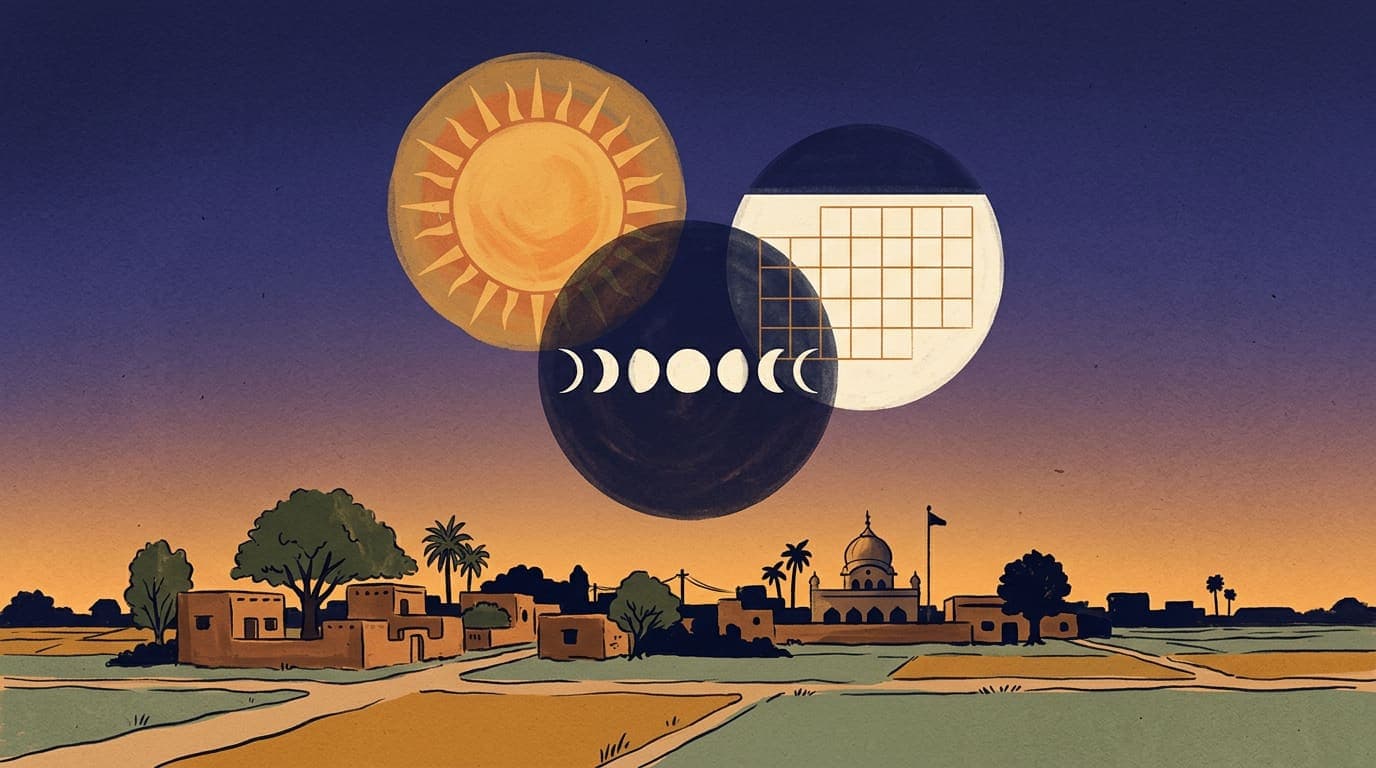
For most of Sikh history, dates were kept using the Bikrami calendar (Vikram Samvat), the system in common use across northern India. The Bikrami calendar is lunisolar. It combines lunar months, which follow the phases of the moon, with solar months that begin when the sun enters a new sign of the zodiac. In Punjab the first day of each solar month is called Sangrand, and the full moon and new moon are known as Puranmashi and Masya.
Because the Gurus lived within this system, the historical sources that record their lives usually give dates as Bikrami months and lunar days. The birth of Guru Gobind Singh Ji, for instance, is traditionally dated to the seventh day of the bright half of the month of Poh.
The difficulty is that lunar dates move against the solar year. A Gurpurab tied to a lunar day can fall in December one year and January the next. In addition, the Bikrami solar year is slightly longer than the tropical year used by the Gregorian calendar, so even the solar Sangrand dates creep later by roughly one day every six to seven decades. For a community increasingly spread across continents and working to Gregorian schedules, this created practical confusion as well as a sense that Sikh dates were borrowed from another tradition's reckoning.
How the calendar was developed
The modern Nanakshahi calendar is closely associated with Pal Singh Purewal, a Canada-based Sikh engineer who began studying Sikh calendrical questions in the 1960s. His aim was a calendar that would keep Sikh observances on stable dates and give the community a reckoning of its own.
Purewal's proposals were discussed widely during the 1990s. A group of scholars convened through the Institute of Sikh Studies in Chandigarh examined them, and a report was submitted to the Shiromani Gurdwara Parbandhak Committee (SGPC), the elected body that manages Sri Harmandir Sahib and historic gurdwaras in Punjab. The SGPC's general house passed a resolution in favour of the calendar in 1998, and a version was used for some observances around 1999, the three-hundredth anniversary of the Khalsa.
The SGPC formally approved the calendar at the start of 2003, and it came into effect from 1 Chet of Nanakshahi year 535, which was 14 March 2003. It was approved by Sri Akal Takht Sahib and publicly released in Amritsar.
The design principles
The calendar rests on a handful of clear rules:
- A tropical solar year. The year length matches the tropical year of about 365.2422 days, the same basis as the Gregorian calendar. This keeps the calendar aligned with the seasons indefinitely.
- An era counted from 1469. Year 1 corresponds to 1469 CE, the year of Guru Nanak Dev Ji's birth.
- A fixed New Year. The year begins on 1 Chet, which always falls on 14 March.
- Fixed month lengths. The first five months have 31 days each and the remaining seven have 30, making 365 days.
- A leap day in Phagun. In years when the Gregorian calendar adds 29 February, the last month, Phagun, gains a day and has 31.
- Fixed dates for observances. Most Gurpurabs and historical anniversaries were assigned permanent Gregorian dates. In the original calendar, for example, Guru Gobind Singh Ji's Prakash Purab falls on 5 January, Vaisakhi and the founding of the Khalsa on 14 April, the martyrdom of Guru Arjan Dev Ji on 16 June, and the martyrdom of Guru Tegh Bahadur Ji on 24 November.
The twelve months
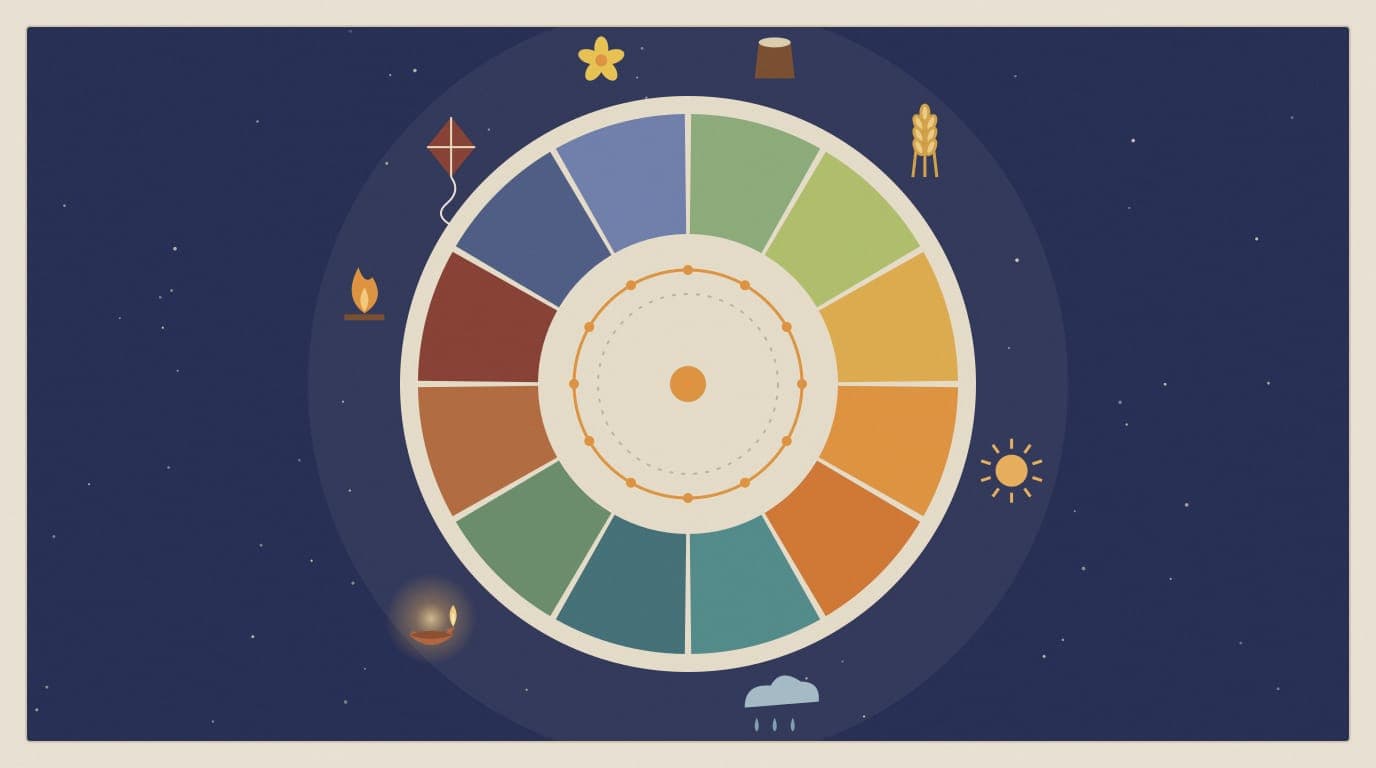
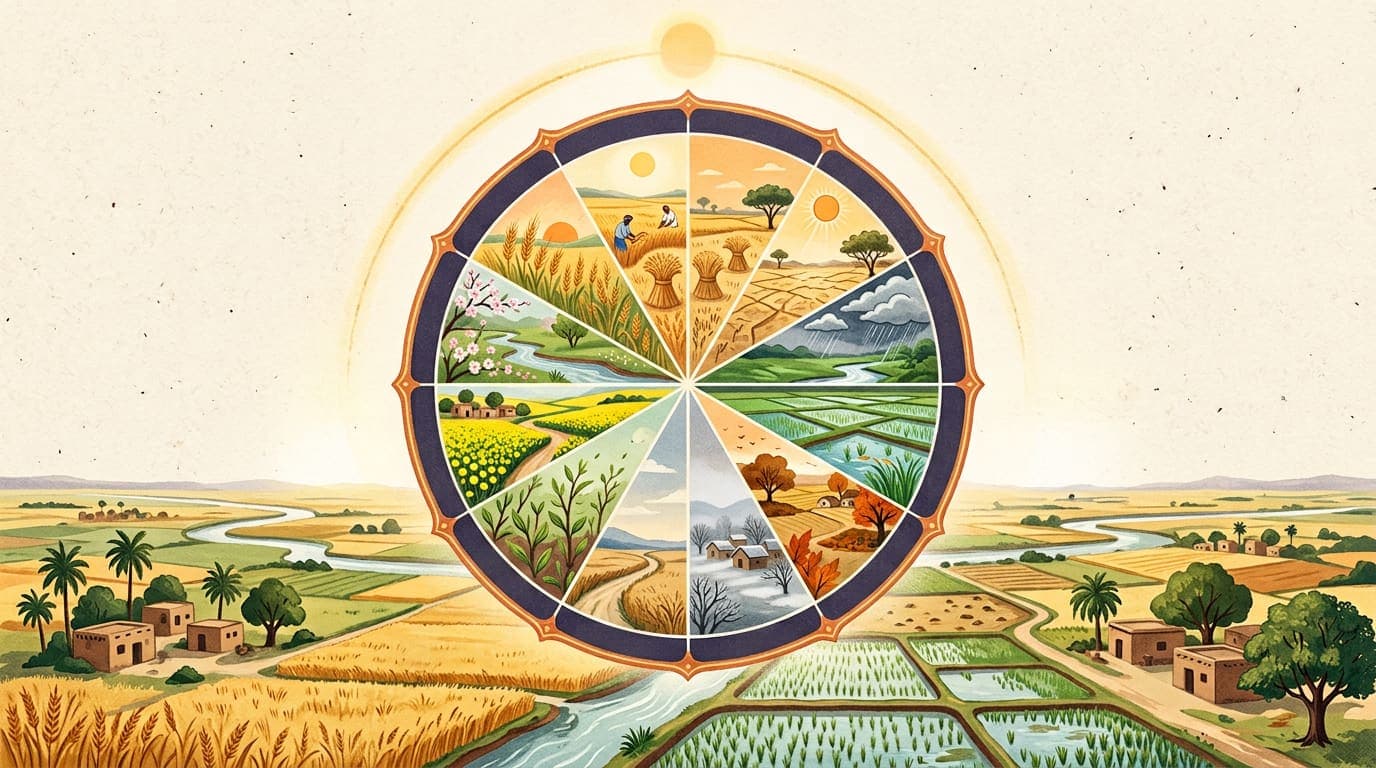
The Nanakshahi months carry the familiar Punjabi names. These names appear in Sri Guru Granth Sahib Ji in two compositions called Barah Maha ("twelve months"): one by Guru Nanak Dev Ji in Raag Tukhari and one by Guru Arjan Dev Ji in Raag Majh. Both use the passing seasons of Punjab as a way of speaking about the soul's longing for the Divine, and many gurdwaras recite the relevant verse of Barah Maha on each Sangrand. The Nanakshahi calendar is sometimes described as built around this cycle.
| Month | Gurmukhi | Begins (original calendar) | Days | Season in Punjab |
|---|---|---|---|---|
| 1. Chet | ਚੇਤ | 14 March | 31 | Spring |
| 2. Vaisakh | ਵੈਸਾਖ | 14 April | 31 | Spring harvest |
| 3. Jeth | ਜੇਠ | 15 May | 31 | Early summer |
| 4. Harh | ਹਾੜ੍ਹ | 15 June | 31 | Peak summer heat |
| 5. Sawan | ਸਾਵਣ | 16 July | 31 | Monsoon |
| 6. Bhadon | ਭਾਦੋਂ | 16 August | 30 | Late monsoon |
| 7. Assu | ਅੱਸੂ | 15 September | 30 | Early autumn |
| 8. Katak | ਕੱਤਕ | 15 October | 30 | Autumn |
| 9. Maghar | ਮੱਘਰ | 14 November | 30 | Early winter |
| 10. Poh | ਪੋਹ | 14 December | 30 | Winter |
| 11. Magh | ਮਾਘ | 13 January | 30 | Deep winter |
| 12. Phagun | ਫੱਗਣ | 12 February | 30 (31 in leap years) | Late winter |
You will also see alternative English spellings: Chetar for Chet, Visakh or Baisakh for Vaisakh, Har for Harh, Kattak or Kartik for Katak, and Phaggan for Phagun. They all refer to the same months.
How to work out the Nanakshahi year
Because the year begins on 14 March, the conversion depends on the time of year:
- On or after 14 March: Nanakshahi year = Common Era year − 1468.
- Before 14 March: Nanakshahi year = Common Era year − 1469.
| Gregorian date | Nanakshahi year |
|---|---|
| 14 March 2003 | 535 (the year the calendar came into effect) |
| 1 January 2026 | 557 |
| 14 March 2026 | 558 begins |
| 1 January 2027 | 558 |
| 14 March 2027 | 559 begins |
Many jantris (printed almanacs) and gurdwara notices give both dates side by side, for example "1 Katak 558 Nanakshahi / 15 October 2026".
How it differs from the Gregorian calendar
Since both calendars follow the tropical year, the Nanakshahi and Gregorian calendars stay locked together. The differences are in structure and meaning:
- Starting point. The Gregorian year starts on 1 January; the Nanakshahi year starts on 14 March.
- Era. Gregorian years count from the traditional date of the birth of Jesus; Nanakshahi years count from the birth of Guru Nanak Dev Ji.
- Month names and lengths. Nanakshahi months use Punjabi names and do not line up with Gregorian months, so each Nanakshahi month straddles two Gregorian ones.
- Leap day. Both add a day in the same years, but the Nanakshahi calendar places it at the end of Phagun rather than in February as a separate date.
For a family in Toronto, Birmingham or Melbourne, the practical benefit is that a fixed Nanakshahi date is also a fixed Gregorian date, so an observance can be planned for the same day every year.
The 2010 amendments and today's situation
In 2010 the SGPC introduced amendments to the calendar after objections from a number of traditional Sikh institutions and orders. The amended version returned Sangrand to Bikrami reckoning and moved several observances, including Guru Gobind Singh Ji's Prakash Purab and the martyrdom anniversary of Guru Arjan Dev Ji, back to lunar dates. In later years the calendar published by the SGPC has been widely described as essentially Bikrami in method, even though it retains the Nanakshahi name.
Many gurdwaras, particularly in North America, the United Kingdom and elsewhere in the diaspora, continued to use the 2003 version, now often called the Mool (original) Nanakshahi calendar. The Pakistan Sikh Gurdwara Parbandhak Committee has also remained with the original version. The result is that in some years the same Gurpurab is observed on different days in different places.
The arguments on each side are sincere:
- Supporters of the original calendar value fixed, predictable dates, a reckoning distinct to the Sikh tradition, and ease of planning for communities living by the Gregorian calendar.
- Supporters of the amended calendar emphasise continuity with the dates recorded in historical sources, the practice of long-established Sikh institutions and orders, and the shared cultural rhythm of observances that fall alongside those of neighbouring traditions.
Sri Akal Takht Sahib and the SGPC have both said that the question falls within the Panth's own processes, and discussions about a common calendar have continued. NanakShahi does not take a position in this debate; we explain both systems so readers can follow whichever their sangat uses.
Common misconceptions
"The Nanakshahi calendar is simply the Punjabi calendar." The month names are shared, but "Punjabi calendar" usually refers to the traditional Bikrami system, which works differently. Our explainer on the Nanakshahi, Bikrami and Gregorian calendars sets out the differences in detail.
"It is a lunar calendar." The Nanakshahi calendar is solar. The lunar dates you see in some Sikh jantris come from the Bikrami system, which is still used for certain observances.
"Nanakshahi dates are the dates on which events happened." The fixed dates are conversions. Historical sources record events in Bikrami terms, and scholars have to convert them, sometimes with uncertainty about which calendar convention a source used. A fixed date is a way of commemorating an event consistently, not a claim that the event fell on that Gregorian date.
"There is only one Nanakshahi calendar." As explained above, the original 2003 calendar and the calendar the SGPC publishes today differ, so it is always worth checking which one a notice or app is using.
How people use it today
In daily life, most Sikhs use the Gregorian calendar for work and school and refer to Sikh reckoning for religious occasions. The Nanakshahi calendar appears in:
- Annual jantris published by the SGPC and by gurdwaras and organisations abroad, listing Gurpurabs, Sangrand, Puranmashi and Masya.
- Gurdwara notice boards and newsletters, which usually give the Nanakshahi date alongside the Gregorian one.
- Sangrand programmes, when many gurdwaras hold a special diwan and read from Barah Maha.
- Apps and websites, which vary in which version they follow and should be checked against your local gurdwara.
If you are planning around a particular date, our practical guide to Sikh dates for families and communities walks through the steps, and the guide to Gurpurabs and Sikh festivals lists the main observances through the year.
Why it matters
The Nanakshahi calendar is sometimes treated as a technical dispute about leap days and lunar months. For many Sikhs it is more than that. How a community keeps time shapes how it remembers. A calendar decides when a family gathers for Akhand Path, when children hear the story of the Sahibzade, and whether sangats in Amritsar, Surrey and Southall stand in Ardas on the same morning.
Understanding the calendar, and the reasons behind its different versions, helps you read any jantri with confidence and approach the debate with patience. Whichever calendar your gurdwara follows, the purpose is the same: to remember the Gurus, and to let that remembrance shape the year.
Frequently asked questions
What year is it in the Nanakshahi calendar?
Nanakshahi years begin on 1 Chet, which is 14 March in the original calendar. Subtract 1468 from the Common Era year for dates on or after 14 March, and 1469 for dates before it. Nanakshahi year 558 began on 14 March 2026.
Who created the Nanakshahi calendar?
The calendar was designed by Pal Singh Purewal, a Canada-based Sikh engineer who worked on Sikh calendrical questions for decades. His proposals were studied by scholars in the 1990s and the Shiromani Gurdwara Parbandhak Committee adopted the calendar in 2003.
Why do gurdwaras celebrate some Gurpurabs on different dates?
Some communities follow the original 2003 Nanakshahi calendar with fixed dates, while the SGPC has used an amended calendar since 2010 that sets many observances by the lunar Bikrami system. The two can place the same Gurpurab weeks apart in a given year.
Is the Nanakshahi calendar lunar or solar?
It is a solar calendar based on the tropical year, the same basis as the Gregorian calendar. That is why its months begin on the same Gregorian dates every year.